


Chris Maylor, who runs a Saddleworth Discovery Walks blog and Facebook page, looks at how to navigate around some of Saddleworth’s historic landmarks.
For more information about local walks, email Chris at saddleworthdiscoverywalks@gmail.com, or visit his blog or Facebook page.
Start/Finish: Saddleworth Museum car park in Uppermill
Grid: SD 996 055
I conducted this short walk one evening at the end of a lovely spring day. Flat throughout its course and easy underfoot, the route is suitable for people of all abilities and is wheelchair accessible too.
From the car park adjacent to the Saddleworth Museum, I turned north along Uppermill’s High Street, which is part of the former Oldham-Standedge turnpike road built in 1792. Turnpike Trusts were established by Acts of Parliament between 1706 and the 1840s to improve trade routes and the name ‘turnpike’ derives from the spiked barriers erected across the road at some of the toll-houses.
Although many of the shops in the village had closed, the pubs, café bars and restaurants were alive with customers enjoying a pleasant evening.
After passing through the square and beyond Kenworthy Gardens, I searched out an old milestone which is hidden against a wall among some undergrowth. This historic marker has been damaged but still bears the inscriptions of Huddersfield and Ashton.
In 1767, it was made compulsory for mileposts to be positioned along turnpike roads to inform travellers of direction and distance. In addition, they helped horse-drawn coaches to maintain their schedule and set fares. Prior to the uniformed postal rate being introduced in 1840, postal charges were often calculated using milepost markers.
Continuing on, I passed Saddleworth School, immediately beyond which, at the foot of Ryefields Drive, stands a stone building with a bricked-up doorway. In 1824 this house became the Brownhill Toll House from where the toll fees were collected from traffic coming into Uppermill from the north.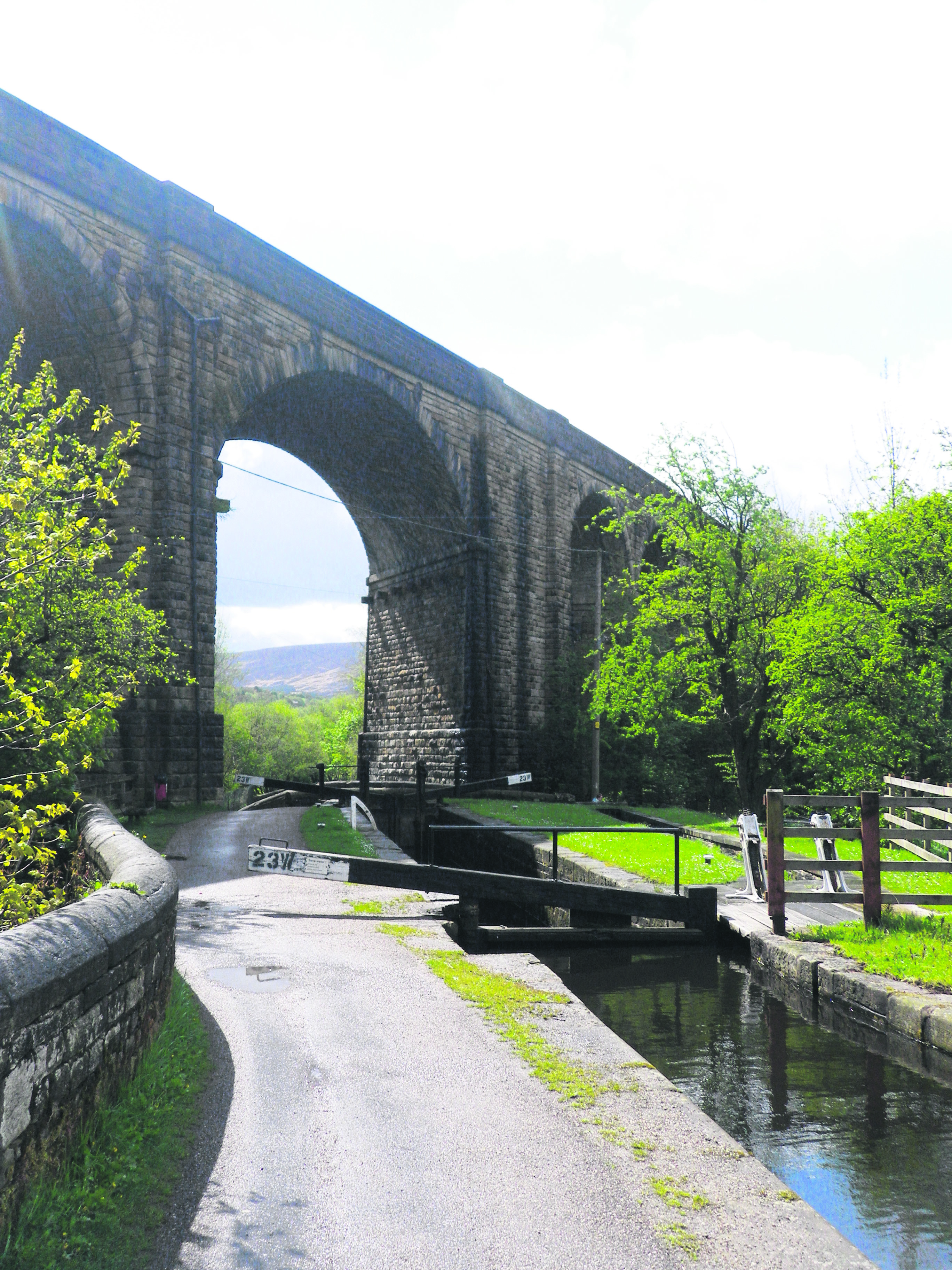
A little further on, I passed underneath the massive, grade II listed, Uppermill Viaduct. Its enormous stone arches span the width of the valley supporting the railway, along which trains travel between Manchester and Huddersfield.
Turning left, I enter the car park of Brownhill Visitor Centre. This former transport depot once housed a Countryside Visitor Centre which was staffed by countryside rangers. Now it is the lime Kiln Café where I enjoyed a cup of refreshing tea and a home-made cake.
Leaving the café, I headed south along the towpath of the Huddersfield Narrow Canal. Built in 1794, the 20-mile long canal has 74 locks and runs between Ashton and Huddersfield. The summit of the canal is 645 feet above sea level, making it the highest navigable waterway in Britain. To the north, the Standedge Canal Tunnel cuts through the Pennines and is the longest, highest and deepest canal tunnel in Britain.
At Lime Kiln Lock, I passed underneath the unusual skewed arch of Saddleworth Viaduct. Glancing down at the heavy wooden lock gates several fish broke the surface of the still waters while overhead a couple of swallows caught insects on the wing.
From here on, the towpath is sandwiched between the canal and the River Tame, and as I continued the suns weakening rays struggled to break through the budding canopy of overhanging trees.
Opposite King George the V playing fields, a young family crossed the stepping stones which, when the waters run low, provide dry passage across the River Tame. On the rivers western bank, nestled amongst the trees and foliage is a metal sculpture intended to form part of a series of art works for a planned sculpture trail.
A little further on is the picturesque Moorgate Bridge, where a beautifully maintained narrow-boat was moored. At this point the towpath ends, and I crossed the bridge to continue my walk along the opposite bank. Beyond here are the Wade Lock Moorings, where I stood a while watching several broods of ducklings frolicking in the still waters among the berthed canal boats.
Passing Wade Lock, I emerged onto Oldham Road. Turning right I walked away from Uppermill for a short distance, past the site of another former toll house, to take a look at the Brayshaw and Booth mile plate which stands outside No 38.
Retracing my steps, I headed back towards the village, to the statue of local poet, writer and historian Ammon Wrigley. Opposite here once stood the Wade Lock Toll House.
Returning to the car park, I reflected on an enjoyable walk – you don’t always have to venture onto the high hills to see wonderful sights while in search of Saddleworth’s history.

You must be logged in to post a comment.