


LITTLE GEORGE Hopkinson could hardly believe his eyes when he spotted a bulky shape lurking in a patch of nettles at his family’s Uppermill farm…
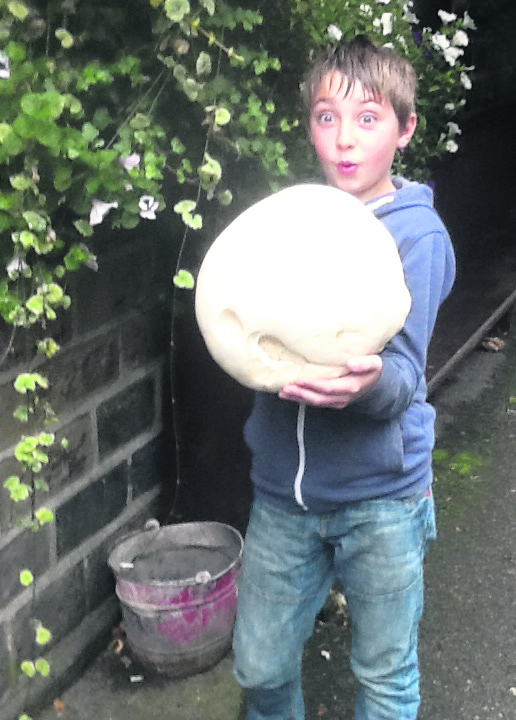
At first, the curious 12-year-old thought he had discovered a big mushroom but instead further investigation revealed a giant puffball.
In fact it was so big George called his father Brian to examine the monster which weighed more than eight pounds and had a circumference of 38 inches.
Saddleworth School pupil George, who lives at Higher Harrop Cross Farm, said: “We found a puffball on our farm last year – but it was small. This was a giant!”
Foraging experts say the giant puffball is identifiable by its enormous size, shallow craters, misshapen spherical shape, lack of a stipe (stem) and bright smooth white skin with irregular cracks at maturity.
Former park ranger Tim Edge pointed to a book “Food for Free” for guidance.
He said: “Of the four native puffballs, the giant puffball truly deserves its name. They commonly grow from four to 12 inches in diameter, although they can be bigger.
“They grow throughout the country from woods to pasture but I’ve never been lucky enough to find one locally.”
Tim, from Uppermill, said the puffball’s Latin name is Lycoperdom gigantium and they often grow in circles.
“Once they begin to age the inside starts to turn brown and then slowly collapses to a powdery green mush. These are the spores for the next generation,” he added.
“A specimen the size of Georges could produce six to seven billion spores.”
Other foragers highlighted the importance of cutting all puffballs in half to be certain there is no sign of gills and that the interior tissue is uniformly white.
If it is yellowish or brown this means it is approaching maturity and might have an off-flavour or possibly be toxic. The outside skin should not be eaten if it is tough, leathery, or dirty.
Never wash puffballs with water as they will become very soggy. They can be stored for two to five days in a refrigerator without losing significant quality.
Meantime, George delivered his bumper find to Julian Taylor, from the nearby Church Inn on Church Lane, who turned it into a mouth-watering feast.
Julian said: “I cut the snow white flesh into rump steak sized slices then pan fried it in virgin oil with finely chopped shallots and garlic purée.
“I cooked it until lightly golden and the shallots had just started to caramelise then added four ounces of Chardonnay and served – delicious.”

You must be logged in to post a comment.