


Mark Barrow looks at how Springhead decided to remember their fallen heroes (with help from local archives)
SADDLEWORTHIANS MA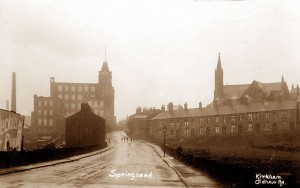 KE the treacherous trip to Pots and Pans to remember fallen servicemen – but for almost 30 years one Saddleworth village was excluded from this mark of respect.
In December, I wrote about the bitter divide over the erection of a community cenotaph that engulfed the area following World War One.
The argument split Saddleworth in two: whether to unveil an obelisk or to build something more practical – “our brave lads died for something better” (than a cenotaph), as local historian and scientist Brandon Brierley put it.
Yet Springhead’s decision to ‘go it alone’ left them out of the debate as they decided to follow the second option.
Their pragmatic residents used interest from public conscription payments to provide educational scholarships for children dependent on those who fought in the war.
This scheme became a success but by the late 1920s Saddleworth Council wondered whether something practical, corresponding with the scholarships, would be a positive step.
Springhead embarked on another commemorative project, as the District Council paid £250 for a property on Gorton Street, which became the District Nurse’s new house.
The Pots and Pans divide simultaneously continued, with the idea of each village erecting a memorial becoming a popular alternative, and Denshaw had already taken this course.
The argument was finally settled when the foundation stone of the Pots and Pans obelisk was laid by Captain Schofield’s wife in May 1923.
Of course, Springhead’s decisions meant they didn’t appear on the memorial; something which didn’t change until 1951.
Following World War Two, the Springhead Branch of the Royal British Legion suggested the names of those Springhead servicemen who died in both wars be added to Pots and Pans.
Due to the creation of the National Health Service, the Gorton Street nurse’s home was sold, leading to the Springhead Memorial Trust financing additional plaques, which were added without rearranging the others.
However, it did mean the names faced east, away from their village (the plaques supposedly faced the village they were respecting), but, at long last, Springhead received written commemoration of their servicemen.

You must be logged in to post a comment.