


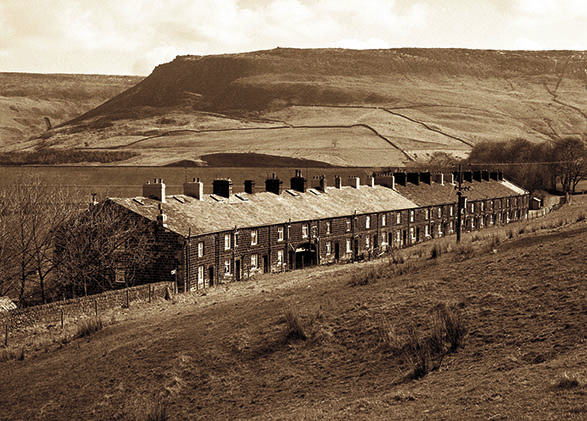
THERE MUST be many people who live near or visit Dovestone Reservoir in Greenfield who wonder what a row of houses is doing at this seemingly tranquil location.
To the estate agent these have now become cottages but they are in fact a terrace of mill workers’ houses and they were one of the first of their industrial kind built in the Saddleworth area.
The terraced houses in question were built over a period of years between 1820 and the 1860s as a series of extensions by the owners of the nearby Greenfield Mill with the specific purpose of providing accommodation for the workers at what was then a fairly remote location.
The number of houses in the terrace eventually grew to more than forty back-to-back and hence became locally known as ‘Forty Row’, though over time these have been knocked through to create twenty-plus houses.
The houses are part of the history of Greenfield Co-operative Society, Saddleworth’s first co-operative society, as the first meeting was held in them – effectively the first step towards the co-operative movement in Saddleworth.
One of the houses at various times acted as a meeting place for Sunday schools and religious services and served as a chapel for navvies who worked on the building of the reservoir at Chew.
It is interesting that we tend to imagine the villages of Saddleworth past to be as they are now but that certainly isn’t the case.
When they started building ‘Forty Row’ Greenfield as a village didn’t exist – it was simply a settlement consisting of Greenfield farm and mill.
Chew Valley Road simply had the toll bar at Frenches, the houses Lower Arthur’s and Spring Grove, ending at a small group of houses at Road End, which was literally the end of the road.
The actual village developed after the 1850s with the expansion of the textile industry as the building of more mills saw further stone terraces erected and subsequently the name Greenfield was adopted for the general area.

Grew up in Greenfield and spent much of my childhood in Chew Valley. Wonder whether anyone else has noticed that “Dovestones” has been renamed as Dove Stone. Would be interested to know if anyone else feels it should have been left alone.
I have asked this question to a few people and was recently told that Dovestones is the name of the reservoir and Dovestone is the name of the whole site.
I asked the RSPB lady the reason for the change and she said it was because there is only one stone that looks like a dove…. it’s been Dovestones longer than it’s been a RSPB site 😉
And the stone she’s referring to is Duck Stone!!
I’ve always known it as Hey Top.
The properties were rented from Robert Fletcher & Son by their employees.
Rents were 5 shillings per week or half a crown for a back to back. This included free electricity supplied from the factory. Hence the lack of a gas main until recent years.
Hi there
I spent the first 8 years of my life living in number 22 hey top which was the end house from 1953-1961
My Father Percy Kelsey was the head gardener at Fletcher’s in those days . I remember Chew valley before it was flooded to make way for the reservoir . I cant remember if it was completed before we left in July 1961 I suspect not .
I remember lots of hikers going past our house every weekend on there way up to Indians head and pots and pans , I also remember Mr Greenwood bringing up food supplies once a week and the weekly visit by the coal man. Going towards the valley there was a sharp bend in the road which was called the Yettie and nearby a stable which housed a horse called Dobin.
The boss of the mill at the time was a Mr Ross if I am not mistaken . There was also a tragic accident in the river there a young girl by the name of Omara drowned I cant recall her first name but her brother was called Trevor
Hi Austin do you remember the Leo family that also lived on battery row?
They would have been Roy and Nora Leo? Nora was a Gallagher before the married. They were my grandparents and I know my mam Linda Leo would have spend her early years living in battery row along with her brothers David and Geoff before moving up to the stand . mam was born in the house in 1956 . Do you remember any of the family?
Dear Austin, I remember you and your brother David. My sister was Called Lillian and she was 7 years old when she died. I went onto become foreman of the engineers shop at Robert Fletchers and worked there for 32 years until It closed. Lots of memories of growing up at Heytop some great, and some sad. Hope you and your family are well best regards Trevor
My father worked on Greenfield Farm from 1954 to 1960. We lived in a cottage at Nut Bottom And could see the Flat roof of the Ross’s house from our rear bedroom widow.
My cousin who lived with us says she used to walk your sister Lilian to school.
My brother and I both went to St Mary’s For a short while and my sister was born in the cottage.
I have happy Childhood memories.
Hi Trevor, I bumped into you in 1976 on a trip home to Greenfield and in 2004 I visited the closed paper mill.
We went to the same schools, I came to Australia in 1967.
I had no idea about your sister until reading this, hope you are well.
Warm Regard
Josephine McDonald
To Austin, This is Peter Sinderby, Old memories from hey top when we used to play. you run one day and thought it was a toffee and you picked it up to eat it and it was a worm hahaha, we all laughed, sorry to hear about David, We use t have some good times up there playing in the woods & sugar lump. Nobody left at hey top now from them days and are all being rented private.
I forgot to add my fathers friend lived at Hey Top he was called Maurice Burgess.
Hi all, jim here I used to live at hawks yard bottom of pots & pans, i used to go to the shop on the bend of isle of sky rd coming up from clarence pub,
That was owned by Marion Middleton, she ran a small farm,toffee shop and a small cafe.