


SADDLEWORTH calls itself home to many things – it can now add one of Britain’s foremost economic historians to a lengthy list.
And Dr Victoria Bateman admits many of the facts detailed in her latest book ring true from her childhood.
The former pupil at Saddleworth School is the author of Economica: A Global History of Women, Wealth and Power.
Described as the untold story of how women made the world wealthy, it has been named as one of the best books of 2025 by the Financial Times.
Female workers helped to build the Great Pyramid of Giza and to plumb the city of ancient Rome.
Women dominated London’s brewing trade during medieval times, along with countless other examples.
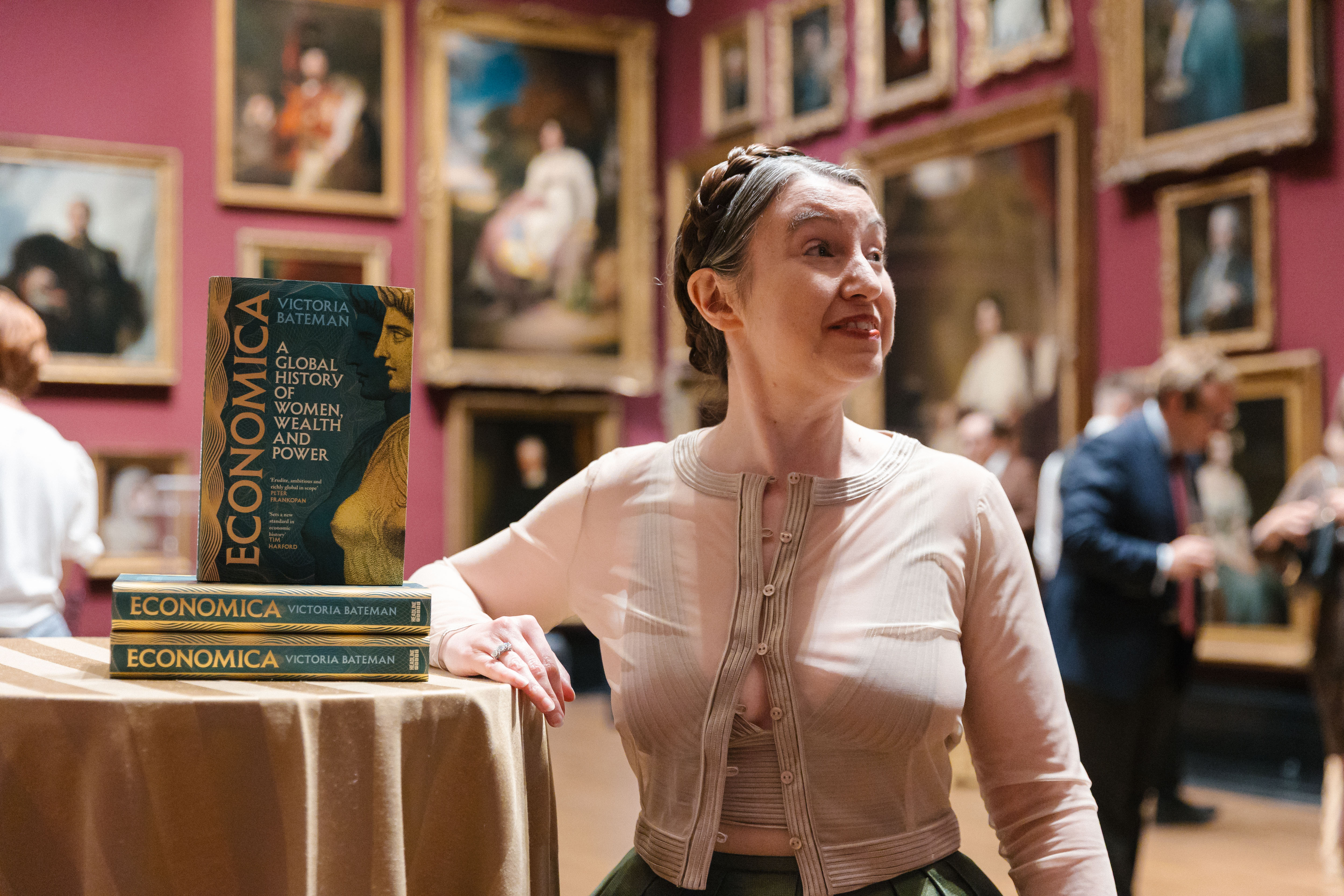
But having been brought up in Greenfield, before moving to Lees and attending Greenfield Primary School before Saddleworth School, Oldham Sixth Form College and Cambridge University, she knew all about something termed ‘girl power.’
Speaking to Saddleworth Independent, Dr Bateman said: “Greenfield was the majority of my childhood, between the ages of about six and 13, and seeing powerful female figures was definitely an inspiration.
“When I was growing up, my grandma, Joyce Chadwick, had this phrase she’d always say to me, ‘Victoria, working class women have always worked.’
“In other words, don’t expect to be a housewife. She’d tell me how she and the ladies she worked with in the cotton mill developed a kind of sign language so they could communicate with each other during the working day because the machinery was so noisy and clunky.
“I knew really from the local stories, from the family history, how instrumental women had been to the economic fortunes, not just of the north of England, but of the country.
“But what was interesting when I went to Cambridge University to formally study economic history was how little women were mentioned in the textbooks.
“We have this idea that women have spent most of history as housewives and only really joined the workforce in the 20th century as a result of the World Wars in which women started to do men’s jobs.
“But what I tried to show in this latest book is that from the beginning of human history, women were hunting alongside men, they were building pyramids alongside men, they were plumbing in ancient Rome, they were brewing beer in medieval times.
 “And they were not just making the cloth in the Industrial Revolution, they were also mining coal, for example.”
Saddleworth, women and industry are interlinked. As Saddleworth Independent told, Lydgate was home to the first unofficial meeting of the Suffragettes.
And while Kent is now home – the accent is definitely no longer local but listening to brass bands on Christmas Day is a nod to her upbringing – that link remains in her work.
Dr Bateman added: “Annie Kenney, such a local heroine.
“Working class women, like Annie, were really there as the voice of ordinary women.
“What I would say as an economist is women’s economic freedoms are the ability to earn and keep their own money.
“Then the freedom for women to spend, to have their own bank accounts – things that are so easy to take for granted today.
“But women like Annie Kenney were really key. The suffragette movement was about so much more than votes for women. It was about women having the same economic rights as men.
“I think it’s a shame when I was growing up that local link wasn’t really talked about in the classroom. In the 1980s and 1990s, feminism wasn’t exactly trendy.
 “And the reason I first got interested in economics and economic history in particular was growing up in Saddleworth and Oldham.
“Oldham had more cotton spindles than France and Germany put together and that whole heritage of the Industrial Revolution was something I saw around me growing up.
“Saddleworth Museum was a huge part of that. I must have visited that endless times as a girl!”
Dr Bateman, 45, will be back on home turf as she delivers the Hajnal Lecture at Manchester University in May after winning the Hajnal Prize for Economic History.
And Saddleworth Museum is on her list of places to go to, as well as being reunited with the man who put her on the path to where she is now, form tutor at Saddleworth School, Dr Bill Mitchinson.
The woman known as Victoria Powell when she attended between 1991 and 1996 recalled: “Being in his form was really transformational.
“A lot of people spent their time in form sessions at the start of the school day, when registers were taken, throwing paper airplanes and that type of thing.
“But he read us Shakespeare and he read us the Iliad. He forced us to learn European country capitals and things like that.
“I had him as form teacher for five years and that time – 15 minutes a day of this kind of wider education of really opening your eyes to things that were not on the school syllabus – was quite transformational.
“When I got my GCSE mock results – and I hadn’t revised – I got As and Bs. He said, ‘Victoria, this isn’t good enough. You can do better than this.’
“That was probably a one-minute conversation, but I thought, ‘If he believes in me, in my last year at Saddleworth School, I’m going to just quietly go to the local library and work.’
“Between Dr Bill Mitchinson and Uppermill Library, that really meant that I could push ahead. I blitzed my GCSEs, then went on to Oldham Sixth Form College, did well in my A-levels and then went on to Cambridge.
“He’s such an amazing man and I’m sure he has had a transformational influence on so many students through his time.”

You must be logged in to post a comment.